

News
Public Inquiries
February 27, 2025
A Legacy of Mistrust
With Module 4 ‘Vaccines and Therapeutics’ of the Covid-19 inquiry drawn to a close, PILC will continue to work with clients to challenge the hostile environment and its impact on migrant communities.
Mistrust of state institutions among migrants, longstanding and well-known to the Government, is not an accident. It is the result of successive Governments perpetuating an atmosphere of fear and overt hostility towards migrants through various laws and policies, including in access to healthcare.
During the pandemic, the deterrent effect of Department for Health and Social Care’s (DHSC) Charging Regulations and the associated data sharing practices with the Home Office was compounded by poor communication and an overall lack of engagement with migrant communities by Government bodies.
The Inquiry’s Counsel to the Inquiry accepted that ,
“the stark disparities of Covid coverage, which is what they were, amongst minority ethnic groups, were rooted in inequality rather than difference… Access barriers, rather than refusal, was obviously the primary barrier to vaccination for many of those communities.”
Hugo Keith KC
Failure to identify leads a failure to deliver
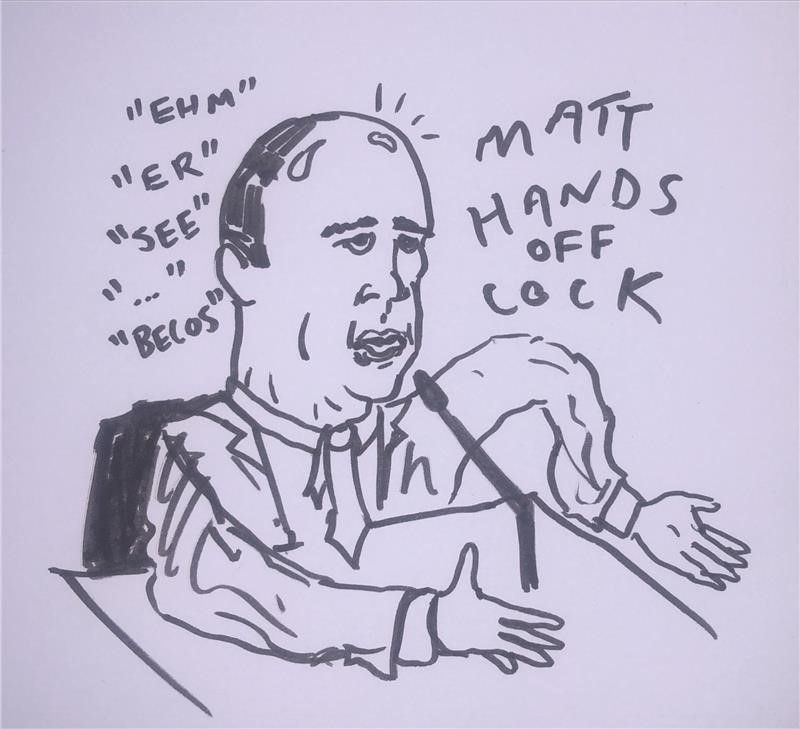
The Inquiry did not receive clear evidence of approaches to understand and address, let alone dismantle structural barriers to healthcare for migrant communities. Mr. Matt Hancock, former Secretary of State for Health and Social Care (the Minister in charge of the DHSC and all its laws and policies from 2018 to 2021) when asked about barriers to vaccine uptake and inequalities stated, in no uncertain terms:
“Yes, we did everything we possibly could, yes. And of course, you know, I'd leave no stone unturned.”
Throughout Hancock’s oral testimony and extensive 70-page witness statement, he failed to acknowledge two pivotal issues of concerns for his department: NHS charging and data-sharing with the Home Office — terms that remain conspicuously absent from his account.
Drawn by PILC Solicitor Joe Latimer
Kemi Badenoch did address barriers to access for migrant communities in her evidence to the Inquiry and in contravention of Hancock, explained that stones had been left unturned and willingly. She told the Inquiry in no uncertain terms that borders should be prioritised over the lives of undocumented migrants and of the nation’s public health:
With illegal immigrants, this is a more fundamental question. These are people who are not in the country legally. Then -- so effectively committing a crime even by being here. Their interactions with the state will be minimal to none, because they will be worried about being...deported. We cannot adjust our health system, in my view, to undermine borders and border security. That would create loads of other problems. So that's just something that I think we need to accept.
The Government, at its highest levels, persistently lacked coordination, commitment and agreement over strategies to eliminate barriers to vaccinations and routinely showed a failure to understand the or address the structural inequities that underpin these challenges.
PILC’s client’s, the Migrant Primary Care Access Group (MPCAG), highlighted to the Inquiry in their closing submissions the principal ways in which the Government abjectly failed to identify and/or remedy the fundamental issue that migrants (both as a sub-set of BAME and as a separate group) faced considerable barriers to accessing vaccines.
Government failures
1. The DHSC’s Charging Regulations. So long as the charging regime remained operational – mistrust, confusion and fear persisted.
2. Data sharing by the DHSC. The DHSC’s policy mandates the sharing of patient data with the Home Office for NHS debts and immigration checks. Despite widespread acknowledgment of this issue, the DHSC refused to implement a data-sharing firewall to protect all patient data during the pandemic.
3. Exclusion from vaccine invitation and booking. The vaccine rollout model, which relied (a) initially on GP registration and records for early invitation and (b) subsequently on NHS numbers to book a vaccine appointment, excluded many vulnerable migrants who had either been refused GP registration or been deterred from registering with a GP for fear of charging and data-sharing.
4. Failure to build trust and refusal to remove barriers. External warnings from frontline migrant organisations were ignored. Internal warnings, including from the top Chief Medical Officer Sir Chris Whitty, went unheeded.
At the core of the barriers lies a pervasive distrust, often compounded by fear, shaping many migrants' perceptions of the Government and other state institutions. This mistrust extends to the NHS, largely due to the DHSC’s role in enabling the incursion of punitive immigration policies, targeted exclusively at migrants, into the healthcare system.
‘Without comprehensive reform, these systemic failings will continue to undermine equitable healthcare access in future public health crises.’
Sonali Naik KC
Conclusion
Trust cannot be rebuilt, or fear dispelled, in a day. Without the assurance that healthcare interactions are free from the risk of immigration enforcement, many migrants - already vulnerable due to socioeconomic and legal precarity - are likely to continue to avoid seeking healthcare, resulting in preventable suffering and unnecessary deaths.
\MPCAG have made the following recommendations to the Module 4 chair as part of the closing submissions:
- Public health policy must always, and in practice, be prioritised over immigration policy.
- The DHSC’s charging regime and associated data sharing between the NHS and Home Office must, without delay, be permanently discontinued or repealed.
- There must be a permanent data-sharing firewall between healthcare services and the Home Office. Without this, trust cannot be built or maintained.
- GP surgeries, hospitals, and vaccine centres must be designated as ‘safe spaces’ where immigration enforcement action is prohibited.
- All barriers to accessing primary healthcare and registering with a GP must be removed. The Home Office must amend its Statement of Requirements with Asylum Accommodation providers to ensure that support is provided to all residents to register with a GP within the first 5 days.
Such reforms would not only benefit migrants but would yield broader societal gains, strengthening the Government’s capacity to respond to a future pandemic.
PILC Legal Team was comprised of Solicitor Ellen Fotheringham, Holly Ahom and Melissa Kizito.
The Migrant Primary Care Access Group are made up of Doctors of the World, Joint Council for the Welfare of Immigrants (JCWI), Kanlungan Filipino Consortium, and Medact.
Counsel included Sonali Naik KC, with legal team Maria Moodie & Maha Sardar of Garden Court Chambers
We will not rest until we see a fairer and more equitable society.
Make a donation today to support our work:
More ways to give


244-254 Cambridge Heath Road London E2 9DA
Phone: 0203 559 6342
Contact us
© Public Interest Law Centre
Charitable Incorporated Organisation in England & Wales - no: 1192355
Registered office: 244-254 Cambridge Heath Road, London, E2 9DA