

News
Public Inquiries
April 16, 2026
Inquiry finds NHS sharing migrant patient information with Home Office undermined COVID vaccine uptake
At 12pm today, 16 April 2026, the UK COVID-19 Inquiry published its Module 4 report on vaccines and therapeutics.
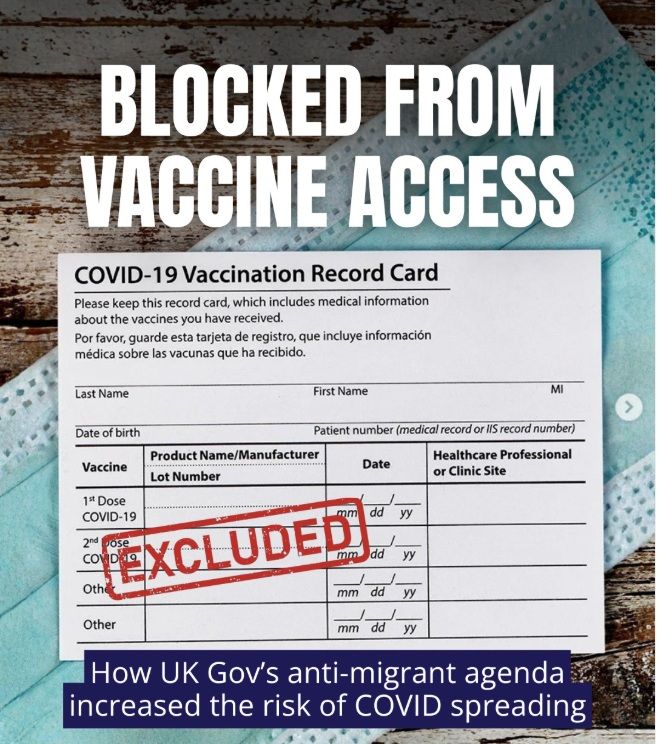
The Inquiry acknowledged the detrimental impact that NHS services sharing migrant patient information with the Home Office had on vaccine uptake, thanks to evidence provided by the Migrant Primary Care Access Group (MPCAG) group[1]. The Inquiry also found low levels of GP registration in migrant communities – due to GPs rejecting applications by migrants on the basis of insufficient paperwork[2] and fears about immigration status[3] – also undermined the vaccine programme.
Despite recognising that these were important root causes of barriers to vaccine access for migrants, the Inquiry did not offer an effective solution to this problem. This is a missed opportunity. Given the time and energy devoted by MPCAG to this issue before the Inquiry, we are disappointed that there was no engagement with the need for a permanent firewall between the NHS and Home Office as a solution to the issues identified by the impact of the NHS charging regime, as recommended by MPCAG. An effective response is urgently required.
MPCAG is a collective of four organisations, comprised of Doctors of the World UK (DOTWUK), Kanlungan Filipino Consortium, the Joint Council for the Welfare of Immigrants (JCWI), and Medact, who specialise in supporting migrants to access healthcare services and contributed evidence to Module 4 of the Covid-19 Inquiry. They bring intersectional expertise on the experiences of migrant communities across the UK during the Covid-19 pandemic.
MPCAG, which represents migrant communities affected by NHS data sharing and charging, including bereaved migrant families and communities, gave evidence to the Inquiry showing migrants were 35% more likely to be hospitalised during the first wave of the pandemic. Death rates among people born outside the UK were far higher, and migrant communities took many months longer to be vaccinated due to fear of NHS charging, data sharing, and immigration enforcement. Doctors of the World UK reported that their clinics saw increased numbers of patients afraid to seek medical help during the pandemic, for fear of incurring NHS debt due to charging policies, or being reported to immigration authorities. This fear of accessing NHS services led directly to deaths from COVID-19, like Elvis, an undocumented Filipino man who died at home in April 2020 after becoming ill and being too scared of immigration enforcement to go to hospital.[4]
Patient and medical confidentiality is sacrosanct, and the cornerstone of every public health system. The current practice of the NHS sharing patient information with the Home Office is a part of the Hostile Environment, designed purely to support Home Office immigration enforcement work that has no public health purpose and, as the Chair acknowledged, is a deterrent to vaccine uptake. NHS services are required to share information about migrant patients with the Home Office, which may be used for immigration enforcement purposes, including immigration raids and immigration decisions.
During the pandemic, the Government refused to end or suspend this data sharing arrangement. Kemi Badenoch, Minister for Women and Equalities during the pandemic, defended the decision to put immigration enforcement above public health, telling the Inquiry “we cannot adjust our health system to undermine borders and border security; that will create loads of other problems. That's just something that I think we need to accept.” This was despite warnings from Professor Chris Whitty, England’s Chief Medical Officer during the pandemic, about the need to make adjustments, namely that “anything that discourages [people coming forward] is a risk to public health” during the pandemic. This was consistent with Public Health England’s concern as early as 2013 that restricting and delaying healthcare access for migrants could increase transmission of respiratory virus outbreaks such as SARS. It cautioned that charging policies could deter people from seeking urgent care, with serious public health consequences.
The Inquiry made a recommendation about the need for greater monitoring to improve vaccine uptake. In light of this, the need for a firewall between the NHS and Home Office is acute – a key point raised by the MCPAG – “increased data collection […] is far from a suitable panacea […] expanding the demands of data recording for individuals can have unintended consequences such as racial profiling, discrimination and breeding a culture of mistrust.” The risks involved with increased data collection were also identified by Professor Chris Whitty - “…people are very nervous about their data being shared for reasons that they don't know and don't agree with […] You have to […] be able to absolutely guarantee the security of the data…”.
We are disappointed that those findings did not lead to the Chair adopting our clear recommendations on NHS charging and data sharing, as we had proposed in order to remove its deterrent effect.
Anna Miller, Head of Policy and Advocacy at Doctors of the World UK, said:
“Over the last decade, our patients have been terrified that they will be reported to the Home Office simply for seeking medical care. During the pandemic, this became a full-blown crisis; fear that going forward to the NHS for a vaccine or medical care would lead to ICE-style immigration enforcement caused many of our patients to avoid life-saving medical care.
During the pandemic, the Government prioritised immigration enforcement over slowing the spread of COVID-19, putting all our health at risk. That was a terrible error. Today the Inquiry has missed an opportunity to learn from this; by ignoring how punitive immigration laws weaken public health, they have left us all at risk for the next crisis.”
Andrea Martinez, Director of Kanlungan Filipino Consortium, said:
“Throughout the pandemic, Kanlungan was at the frontlines of the pandemic supporting the Filipino migrant community and other migrants caught at the intersection of the Hostile Environment and public health policy. Our members were working in the NHS, care homes, and private homes as frontliners, but many were also excluded from these systems of health and social care we all relied on. We lobbied decision makers about what was happening to our community, led Covid-19 information campaigns in Filipino languages, and operated vaccination clinics to support everyone with accessing the Covid-19 vaccination to help our communities stay safe and healthy.
It is disappointing that the Inquiry has not recognised the extent to which immigration policy interfered with public health. Increased monitoring, as the Inquiry recommends, cannot rebuild trust in communities who have learned, through painful experience and grave loss, that sharing their data carries real risk. The migrants who kept this country's health and care systems running during the pandemic deserved better, they deserve a firewall between the NHS and Home Office, and an end to the Hostile Environment, in order to recognize their contribution to this country.”
Lavanya Pallapi, Executive Director at Joint Council for the Welfare of Immigrants (JCWI), said:
"The Covid-19 pandemic exposed this country's hostile immigration system, which treats migrants and undocumented people as completely exploitable and ultimately expendable.
As we and many others warned would happen, the pandemic laid bare and exacerbated the inequalities that these communities already face, as they were locked out of healthcare, denied access to life saving welfare and safe housing, and left to face the pandemic alone.
Under these conditions, migrants and undocumented people were forced to put themselves and their families and communities in danger by continuing to work in unsafe conditions to keep the country going. As a result, Black, racialised and migrant communities had the highest mortality rate during the pandemic. In the years since, instead of support and care, these essential workers and their communities have subsequently been demonised and scapegoated by the government for its own political and economic failings.
The devastating and ongoing impact of Covid-19 on migrant communities was the predictable consequence of deliberately exclusionary policies that prioritise borders over human life."
Col Fallowfield, Campaign & Programme Lead: Health and Human Rights at Medact, said:
“The hostile environment is deadly and the Covid-19 pandemic made it more so. Migrant communities already avoided seeking healthcare before the pandemic because of fears of being charged for NHS care, data sharing and the presence of immigration controls in health service. While exemptions were made for tests, treatment and vaccinations, the door remained firmly shut to those suffering from long COVID or pre-existing conditions. It was a cruel paradox: seek care and risk deportation, or suffer in silence. Nothing other than the abolition of the hostile environment will ensure the health of migrant communities.”
Alisha McSporran, Solicitor at Public Interest Law Centre, said:
“Throughout Module 4, the Migrant Primary Care Access Group put forward clear evidence as to the dangerous impact of immigration policies and enforcement on access to healthcare, including vaccines and lifesaving treatment. Despite the acknowledgement that primary healthcare is not subject to the charging regime, our client’s evidence highlighted the detrimental and deterrent effect of the Hostile Environment policies of data-sharing between the Home Office and NHS. We are disappointed that regardless of this evidence, the Inquiry has not addressed the data sharing in its recommendations, nor adopted MPCAG’s recommendations which would ensure public health policy is prioritised over immigration policy.”
Doctors of The World UK is part of the international Médecins du Monde network. We provide emergency and long-term medical care to people facing barriers to healthcare in the UK and globally. Our work spans humanitarian responses in times of crisis, advocacy for universal access to healthcare, and direct support for marginalised communities including people seeking asylum, survivors of trafficking, undocumented people, and those with no fixed address. For over a decade, we have documented the impact of NHS charging regulations and data-sharing between the NHS and the Home Office on patient health, public health and health inequalities. Our evidence has been submitted to parliamentary inquiries, public consultations and now to the UK COVID-19 Inquiry.
Joint Council for the Welfare of Immigrants is an independent national charity, founded in 1967 to defend the rights of Britain’s migrant communities and fight for a fairer immigration system. For more than half a century, we have challenged policies that lead to discrimination, destitution and the denial of rights. We have provided accessible, high-quality and award-winning legal advice and support to tens of thousands of people, helping them to secure their immigration status, keep their families together and escape poverty. And we are building a community-driven and lived-experience led movement for migrant justice and a more just society.
Medact is a charity that brings together health workers to fight for health justice. We recognise that health injustice is driven by political, social and economic conditions, and we mobilise the health community to take action to change the system.
Kanlungan is a migrant-led charity providing holistic support, advocacy, and access to justice for migrant communities in the UK. We work with migrants experiencing immigration precarity, labour exploitation, domestic abuse, and other forms of vulnerability, offering culturally responsive and trauma-informed services.
The MPCAG is represented by Alisha McSporran, Solicitor (PILC), together with counsel Sonali Naik KC, Maria Moodie and Maha Sardar (Garden Court Chambers).
[1] UK Covid-19 Inquiry, Module 4: Vaccines and therapeutics, A report by The Rt Hon the Baroness Hallett DBE Chair of the UK Covid-19 Inquiry (“Module 4 report”) April 2026, pp.172 – 173, 187 [§§6.64, 6.84 – 6.85].
[2] Module 4 report, p.175 [§6.72].
[3] Module 4 report, p.176 [§6.76].
[4] RAPAR, Yesterday, Elvis Died, 9 April 2020 (https://www.rapar.co.uk/rapar-updates/yesterday-elvis-died).
We will not rest until we see a fairer and more equitable society.
Make a donation today to support our work:
More ways to give


244-254 Cambridge Heath Road London E2 9DA
Phone: 0203 559 6342
Contact us
© Public Interest Law Centre
Charitable Incorporated Organisation in England & Wales - no: 1192355
Registered office: 244-254 Cambridge Heath Road, London, E2 9DA