

News
Public Inquiries
February 16, 2026
Covid-19 Public Inquiry to hear evidence on the pandemic’s impact on society
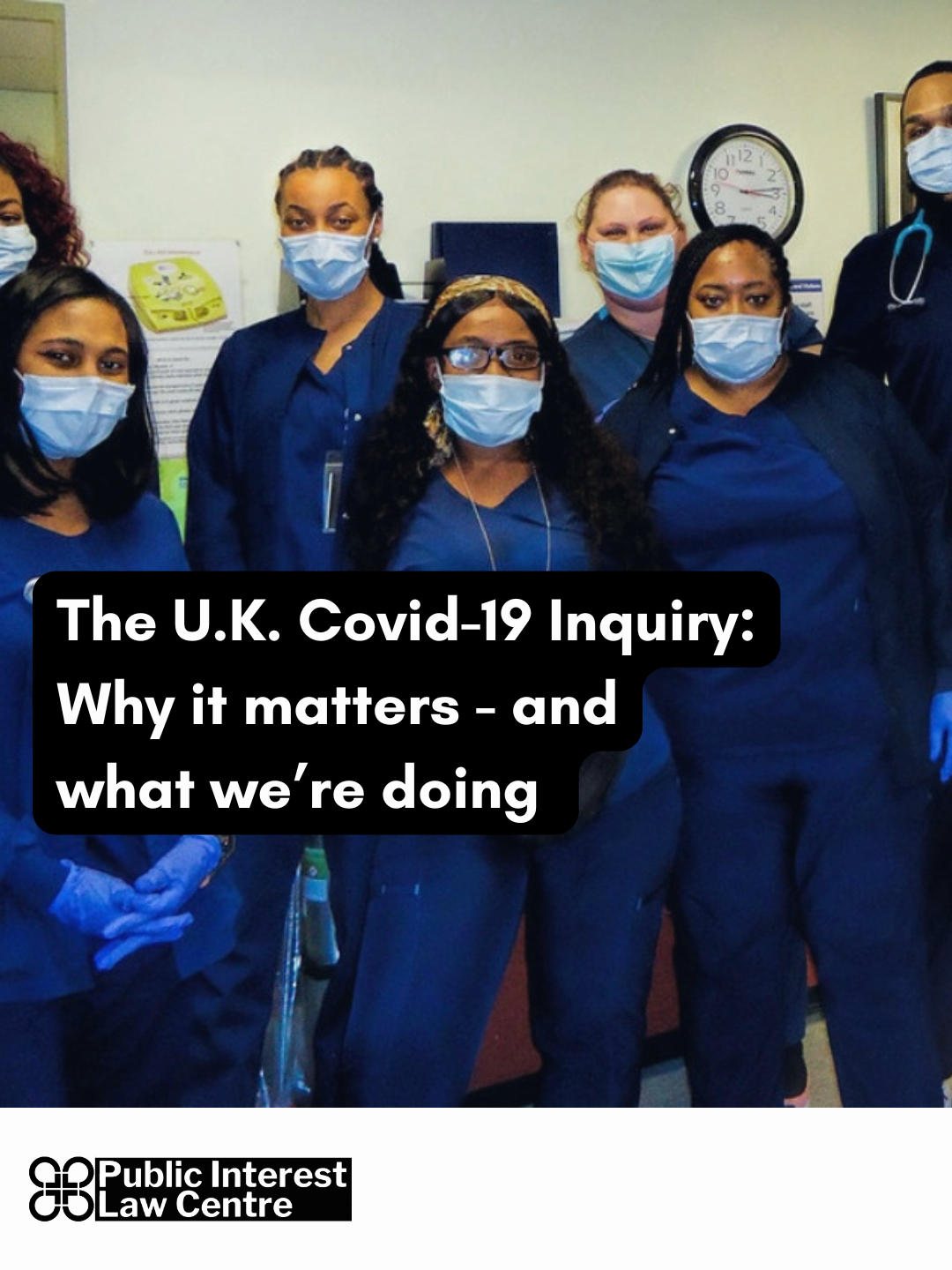
Module 10 is the last module of the Covid-19 UK Inquiry and with these final hearings, the Inquiry has a final opportunity to hear and act upon those voices that often went unheard and unheeded during the pandemic. Module 10 is to examine the impact of Covid on the most vulnerable, key workers, the bereaved, mental health and wellbeing, bringing together the human impact of the pandemic.
The Public Interest Law Centre (PILC) will be standing alongside and representing some of ‘the most vulnerable’, including victim-survivors of domestic abuse, and migrants including people with precarious immigration status, people in the asylum system, and those who worked at the frontlines during the pandemic. PILC represents two Core Participant groups: The Domestic Abuse (DA) Group and the Migrants’ Rights Consortium (MRC).
The DA Group is a collective of three specialist organisations working with victim-survivors of domestic abuse, comprising: Latin American Women’s Rights Service, Solace Women’s Aid and Southall Black Sisters. The DA Group brings together specialist expertise to highlight how the pandemic disproportionately affected victim-survivors of domestic abuse, with a particular focus on those facing multiple disadvantages. The group is represented by Adriana Matrigiani, Solicitor (PILC), together with counsel Liz Davies KC, Marina Sergides and Angharad Monk (Garden Court Chambers).
The DA group will provide sobering and stark evidence on how the pandemic intensified domestic abuse. Many women and children were left trapped with abusers while routes to safety were effectively cut off, particularly Black, minoritised and migrant women.
During the pandemic, demand for domestic abuse services rose sharply, with helpline calls increasing by more than 100%. Migrant women and those with No Recourse to Public Funds (NRPF) were particularly affected, facing exclusion from refuges and emergency housing, with fewer than 5% of spaces available to them. Fear of immigration enforcement, barriers to accessing key services, failures in domestic abuse data collection during lockdown, and unclear public messaging, were among the many reasons why abuse went unreported and cases escalated, leaving many women having to choose between abuse and destitution.
Selma Taha, Executive Director, Southall Black Sisters: “Domestic abuse reached crisis levels during the pandemic. Migrant victim-survivors with No Recourse to Public Funds (NRPF) were placed in a triple bind of Covid-19, domestic abuse, and the ever-present threat of deportation & destitution. The Home Office made a conscious decision not to lift the NRPF condition or extend immigration status and access to support to migrant victim-survivors – a failure that effectively strengthened perpetrators’ power and control at a time of national emergency. We will be submitting evidence to the Covid Inquiry to center the experiences of migrant victim-survivors of domestic abuse and to ensure that these systemic failures are never repeated. We call on the Inquiry to adopt our recommendations for safeguarding some of the most vulnerable victim-survivors in any future public-health crisis.”
Gisela Valle, Director at Latin American Women’s Rights Services (LAWRS): “The Covid Inquiry will hear vital evidence on the pervasive impact the pandemic had on migrant and minoritised survivors of domestic abuse, as well as on the specialist services supporting them during lockdown. The evidence will demonstrate that the structural barriers faced by our communities, intensified by fears of immigration enforcement, language barriers and discrimination, become more severe when government responses failed to account for systemic inequalities.”
Rebecca Goshawk, Director of Business Development: “Women are still living with the lasting scars - both physical and emotional - of domestic abuse suffered during the pandemic. Decision makers overlooked the needs of the millions of women experiencing domestic abuse in the UK, leaving them trapped with their abusers and for many this was life threatening. The Covid-19 inquiry has the opportunity to make life-saving recommendations to protect domestic abuse survivors in future emergencies.”
The MRC is a collective of nine organisations: Doctors of the World UK, the Independent Workers of Great Britain, Joint Council for the Welfare of Immigrants, JustRight Scotland, Kanlungan, Medact, Project 17, Together with Migrant Children, United Voices of the World. Together, they bring intersectional expertise on the experiences of migrant communities across the UK during the Covid-19 pandemic. The MRC is represented by Myriam Naoual, Solicitor (PILC), together with counsel Aswini Weereratne KC, Rowena Moffatt and Lameesa Iqbal (Doughty Street Chambers).
During the pandemic, migrants were often excluded from welfare, housing, sick pay, and access to healthcare. They suffered increased exposure to harm, and many had no choice but to work even if they fell ill, sometimes without access to medical treatment. Fear of NHS charging, data-sharing with the Home Office, and immigration enforcement deterred people from seeking care, despite clear public health warnings. In addition, Module 4 heard how ministers continually ignored warnings from public health experts, including Chief Medical Officer, Professor Chris Whitty, to relax these Hostile Environment measures. Simultaneously, emergency measures such as the ‘Everyone In’ housing initiative were applied inconsistently, leaving many migrants without safe accommodation. The MRC will highlight how NRPF policies and the Hostile Environment weakened the UK’s pandemic response.
Andrea Martinez, Kanlungan Director: “The Filipino migrant community was disproportionately impacted by the pandemic due to many Filipino migrants’ work in the health and social care sector. Additionally, many people with precarious immigration status in our community were excluded from the very services that Filipinos work in because of immigration policies excluding them from healthcare and other support services. Kanlungan was at the frontlines, supporting our community when it had nowhere else to turn to. We hope to honour the memories of all those who died of Covid-19 through this Inquiry and demand the change needed so these tragedies aren’t repeated.”
Anna Miller, Head of Policy and Advocacy at Doctors of the World UK: “Over the last decade, our patients have faced fines and harassment from debt collection agencies and immigration enforcement teams simply for seeking essential medical care. During the pandemic, this became a full-blown crisis; fear of the NHS led many migrants to avoid life-saving Covid-19 treatments and vaccines. This is a unique opportunity to hear and learn from people directly impacted by these hostile environment policies. Their experiences reveal exactly how these measures undermined our pandemic response and put everyone's safety at risk.”
Nick Watts, Director, Together with Migrant Children: “The impact of the pandemic on children has been widely discussed, however children who have, or have a parent with precarious immigration status faced unique vulnerabilities that left them more at risk. Poor quality housing, use of hotels for family accommodation and limited money meant children experienced further harm directly because of immigration policy. This largely forgotten group of children are amongst our most vulnerable, and the Inquiry offers an opportunity to demand change so every child experiences an equal childhood and are not left at increased risk during another national crisis.”
Medact: “All of the evidence from our members and our research highlights that the pandemic exponentially exacerbated the harms caused by the barriers to healthcare access created by the hostile environment. In the face of a suite of policies like the hostile environment, no other measures other than the abolition of such hostile systems can safeguard the health of our community members. Unless these systemic health barriers are dismantled, our members and the people being supported by them, will continue to be excluded from accessing care, face serious health issues and die.”
Rose Bernstein, Interim Executive Director at Joint Council of Welfare of Immigrants (JCWI): “The Covid-19 pandemic laid bare a hostile immigration system that treats migrants and undocumented people as completely exploitable and ultimately expendable.
It exposed and deepened the inequalities migrants and undocumented people already face, as they were locked out of healthcare, and denied access to life saving welfare and safe housing, and left to face the pandemic alone. They were forced to put themselves in danger by continuing to work in unsafe conditions to keep the country going, and yet these essential workers were ignored as soon as the pandemic was over.
The devastating and ongoing impact of Covid-19 on migrant communities was the predictable consequence of deliberate exclusionary policies that prioritise border control over human life."
Further information on Module 10 can be found on the Inquiry website: Impact on society (Module 10) – Public Hearings - UK Covid-19 Inquiry.
Attend in person: Public gallery tickets available via: Public hearings - UK Covid-19 Inquiry
Watch live: Stream on the UK COVID-19 Inquiry YouTube channel UK Covid-19 Inquiry - YouTube
We will not rest until we see a fairer and more equitable society.
Make a donation today to support our work:
More ways to give


244-254 Cambridge Heath Road London E2 9DA
Phone: 0203 559 6342
Contact us
© Public Interest Law Centre
Charitable Incorporated Organisation in England & Wales - no: 1192355
Registered office: 244-254 Cambridge Heath Road, London, E2 9DA