

News
Public Inquiries
November 27, 2024
“If they'd listened to the voices of the workers at the beginning, far fewer lives would have been lost.”
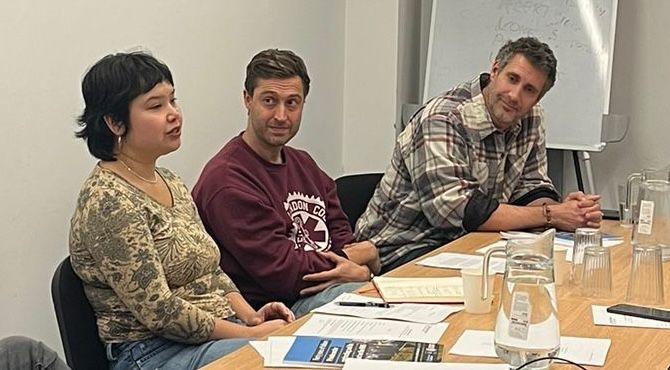
Representatives from Independent Workers’ Union of Great Britain (IWGB), United Voices of the World (UVW) and Kanlungan together as the Frontline Migrant Health Workers Group (FMHWG) share the emotional truth of the conditions migrant workers faced while working on the frontline during Covid.
Background
The Covid-19 Inquiry has been our biggest piece of work in 2023-24 by far. Module 3 highlighted the terrible treatment of migrant healthcare workers, and how it was a direct result of decades of increased privatisation and outsourcing in the NHS.
For PILC’s 2024 AGM, we invited representatives from the three organisations who were Core Participants to share how the pandemic disproportionately affected migrant workers.
“If they'd listened to those voices at the beginning, far fewer lives would have been lost.”
Alex Marshall is president of the IWGB. A medical courier during the pandemic, Alex shared the huge emotional impact that the working conditions had on him and so many other workers.
“There were absolutely zero protections coming from the government or from our employers” he said.
“I get quite triggered talking about it. Because it was... it was madness. I just have these memories of heading in when everyone's staying home, queuing up outside shops at a nice social distance, and I was heading in towards picking up COVID with my bare hands. It was a crazy time.”
IWGB represent migrant workers who have been neglected by larger unions. Throughout the pandemic, workers made demands to employers for better safety measures, sick pay, and protections for vulnerable workers, but many demands were ignored.
“The fact that workers weren't invited up to speak at the inquiry – that is had to be me as president - kind of shows you where their priorities are when it comes to actually listening to the voices of those affected. We should have had so many more voices there who were able to speak about their experiences. It was great that we had the people we did and we did a good job. But if they'd listened to those voices at the beginning, far fewer lives would have been lost.”
“The obstacles for advocating for themselves in the workplace were just so extreme”
Francesca Humi represented Kanlungan in the inquiry. She told us that in May 2020, it was estimated that up to one in four nurses in the NHS who died of COVID were Filipino despite Filipinos only making up 3.8% of the NHS nursing workforce.
There were significant challenges for undocumented workers. “Their experience was a perfect example of when immigration policy, public health crisis, austerity, privatization all overlap” she said.
“It's this really bizarre situation where you have community that's essentially the backbone of the NHS, but simultaneously, because of immigration enforcement and visa restrictions people were so confused... the obstacles for advocating for themselves in the workplace were just so extreme.”
Francesca shared the need for space to share community experiences and remember those who died during the pandemic.
“Outsourcing is not really spoken about. The effects are so pernicious. It's so detrimental.”
Petros Elia is co-founder and general secretary of the United Voices of the World (UVW). He discussed the union's fight against outsourcing through strikes, legal claims, and inquiries. UVW represented workers in government departments, hospitals, and care homes, providing PPE and supporting members who refused to work due to safety concerns. He highlighted how the precarious nature of the contracts of outsourced workers led to such unsafe conditions throughout the pandemic.
“Outsourcing is not really spoken about but there's an estimate 3 million workers who are outsourced in the UK. The effects are so pernicious. It's so detrimental to working terms and conditions, mental health, wellbeing - all of it. Outsourcing should be the number one issue for the for the union movement.”
United Voices of the World (UVW) have successfully ended outsourcing in higher education and in one instance in the NHS. He shared his hope that these wins will snowball and more unions will fight to end the outsourcing of workers.
For Module 3, we wanted to provide a current and historical analysis of the impact outsourcing and privatisation has had on the NHS. On behalf of the FMHWG, we asked for the Covid-19 Inquiry to commission a report.
The Inquiry refused our request.
Together with FMHWG, we felt we had no choice but to commission this report to provide it as evidence to the Covid-19 public inquiry ourselves.
Read Forty years of failure: private sector contracting and its impact on the NHS here.
In the new year, we will host an event to discuss the shocking findings so that you can use it as a tool in your campaigns.
Sign up to our Newsletter In The Public Interest to be the first to find out when the report launch event is.
We will not rest until we see a fairer and more equitable society.
Make a donation today to support our work:
More ways to give


244-254 Cambridge Heath Road London E2 9DA
Phone: 0203 559 6342
Contact us
© Public Interest Law Centre
Charitable Incorporated Organisation in England & Wales - no: 1192355
Registered office: 244-254 Cambridge Heath Road, London, E2 9DA