

News
Open Spaces Project
July 27, 2026
High Court quashes Spurs’ planning permission to develop Whitewebbs Park
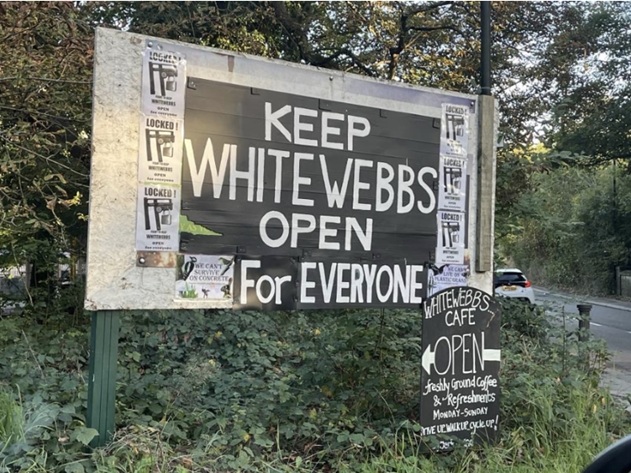
Judge finds Enfield Council misled its own planning committee and breached transparency provisions, renewing hope to save community asset.
The High Court has quashed Tottenham Hotspur Football Co Limited’s planning permission to develop a large area of historic Whitewebbs Park in the London Borough of Enfield following a successful judicial review claim brought by Guardians of Whitewebbs CIC.
The planning permission provided for the development of a 16-hectare football training complex, including major “land reprofiling”, the construction of 10 football pitches, and the exclusion of the public, resulting in the permanent loss of 16 hectares of public parkland.
The claim succeeded on the ground that the council had breached transparency provisions relating to planning applications, resulting in material prejudice to the claimant, and had misled the planning committee about the ecology officer’s views.
A lack of transparency
The documents which ultimately led to the successful claim were provided to a local resident under the Environmental Information Regulations 2004, the equivalent to the Freedom of Information Act 2000 provisions for environmental information, after the Council failed to publish them on its planning register or as background papers to the planning committee report.
The documents revealed serious concerns from the Council’s external Ecology Officer, who had been instructed to advise the Council on the ecological impact of the development, about THFC’s biodiversity net gain claims – that the development would lead to 33% biodiversity net gain (BNG).
The Ecology Officer’s concerns were not made public or incorporated into the officer’s report. The Ecology Officer’s response was recorded in the report as “no objection”.
The judge found that the council had “misrepresented” the views of the Ecology Officer and sought “to sideline” the Ecology Officer’s objection that the 33% BNG claimed by the applicant could not be achieved, while using the ecology officer’s name “as a means of giving credence” to the applicant’s claims.
The judge said: “By not mentioning the Ecology Officer’s disagreement with the 33 per cent plus BNG claim, the committee were given the false impression that he did not disagree with it.”
Materially misleading on a consequential issue
The judge did not accept that the wrong impression of the Ecology Officer’s views given in the officer’s report was “inconsequential or minor”. It was, the judge decided, a “deliberate and considered decision”.
Nor did the judge accept THFC’s argument that the claimed BNG benefit was only a small part of the claimed overall benefit of the development which formed the Very Special Circumstances justifying inappropriate development in the Green Belt.
The judge said: “This was a proposal to turn part of the park into buildings and football pitches. Biodiversity is always likely to loom quite large where construction of that kind is proposed on Green Belt land.”
Can the decision of the High Court be overturned?
THFC can appeal the High Court’s decision to the Court of Appeal. THFC will need permission to appeal, either from the High Court or the Court of Appeal. There is a limited time in which an application for permission to appeal can be made.
Enfield Council and THFC entered into an Agreement for Lease over 54% of the park, amounting to just under 53 hectares, in 2023. The Agreement for Lease is subject to a suitable planning permission being granted. If the High Court’s decision stands, and no further planning permission is granted, the controversial lease to THFC will never materialise.
Benny Hawksbee, chair of Guardians of Whitewebbs, said:
“We are delighted with this outcome. We would like to thank our incredible community who generously funded this case; the Public Interest Law Centre; our solicitor Harriet Child and our incredible barristers Jenny Wigley KC, Alex Shattock and Claudia Hyde, who have gone above and beyond to put our case; the judge Sir Timothy Kerr for his fair judgment, and the community campaign groups Save Whitewebbs and Friends of Whitewebbs Park. Together, we have saved Whitewebbs Park for wildlife and future generations.
“We triumphed against the odds, against a greedy football club worth billions, but this should never have happened. There were clearly failures in assessing the value and biodiversity of Whitewebbs Park, and an emphasis on serving a football club over the local community, their wishes and their right to enjoy Whitewebbs Park in perpetuity. We hope wherever the new council and Spurs have planned for the facility going forward is not public or green space in Enfield and the local community is fully consulted. Nature is not for sale and needs to be protected more than ever!”
Harriet Child, solicitor at PILC, said:
“I hope the huge amounts of money and time wasted on this attempt to take over a public park will be a warning to councils and companies that residents care deeply about public open spaces and will fight hard to keep them. Enfield Council was so intent on pressing ahead with a deeply unpopular plan to lease a large area of this historic park that they misled their own planning committee. Now, the previous administration has been voted out and the decision has been quashed by the Court. The new administration has an opportunity to work with residents and preserve Whitewebbs Park for the next 100 years and beyond.”
Jenny Wigley KC, Alex Shattock and Claudia Hyde, of Landmark Chambers, acted for the Claimant.
For more information about the case and campaign, contact:
Guardians of Whitewebbs: guardiansofwhitewebbs@gmail.com
Public Interest Law Centre: harriet.child@pilc.org.uk
We will not rest until we see a fairer and more equitable society.
Make a donation today to support our work:
More ways to give


244-254 Cambridge Heath Road London E2 9DA
Phone: 0203 559 6342
Contact us
© Public Interest Law Centre
Charitable Incorporated Organisation in England & Wales - no: 1192355
Registered office: 244-254 Cambridge Heath Road, London, E2 9DA