

News
Public Inquiries
August 11, 2026
The SDS Was Not a Rogue Unit – it was deliberate action by the state
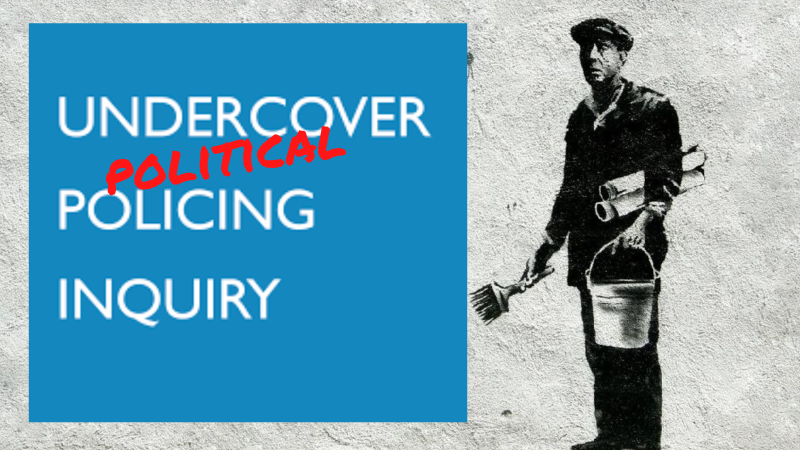
For years, the Metropolitan Police (MPS) has attempted to present the undercover policing scandal principally as a story about misconduct, that is undercover officers (UCO) entering abusive sexual relationships, assuming the identities of dead children, deceiving courts and behaving in ways that should never have been permitted.
Those abuses were appalling, but the evidence now emerging from the Undercover Policing Inquiry (UCPI) points towards a more fundamental conclusion. The real scandal is not simply what individual UCOs did. It was that the SDS was permitted for four decades to infiltrate political organisations and campaign groups when there was no proper justification for deploying such an extraordinarily intrusive policing tactic.
That conclusion has been brought into particularly sharp focus by the evidence of Jon Boutcher, the senior MPS officer who took responsibility for the SDS in October 2007 and closed it within five months. Boutcher was not an opponent of undercover policing. He was an experienced senior officer with a background in serious organised crime and counter-terrorism who understood the legitimate use of covert tactics. Yet when he examined what the SDS was actually doing, he could not understand the justification for infiltrating protest organisations in this way. His ultimate assessment was devastating: allowing the SDS to continue was “fundamentally a strategic failing of the MPS”.
That distinction is crucial. Boutcher argues in his statement to the Inquiry that he did not close the SDS because he had discovered the deceptive sexual relationships or many of the other abuses which have subsequently dominated public discussion of the spycops scandal. He closed it because the deployments themselves could not be justified. He described an organisation characterised by inadequate supervision, poor governance, excessively long deployments and a fixation with “intelligence only” operations.
Most importantly, he could not understand the proportionality of deploying such an intrusive tactic against protest groups. The significance of his evidence is therefore that it moves responsibility beyond individual undercover officers and their immediate managers and towards those who authorised, funded and permitted this system of political surveillance to continue. All eyes should now be on the Home Office, the Cabinet Office and senior civil servants.
Targeting socialist, anti-racist and peace campaigners
Considering who was being targeted amongst our clients, anti-racist campaigners Lois Austin and Hannah Sell; former Labour MP Dave Nellist; anti-war activists Lindsey German, Chris Nineham and John Rees; Youth Against Racism in Europe (YRE) and the Stop the War Coalition. The wider surveillance exposed by the Inquiry encompasses organisations including the Socialist Workers Party, Socialist Party, Anti-Nazi League, Campaign for Nuclear Disarmament and Globalise Resistance. These were organisations campaigning against racism, fascism, war, nuclear weapons and government policy. Yet documents disclosed to the Inquiry show that the 2005–06 Special Branch Control Strategy identified organisations including the SWP, ANL, No Platform, Globalise Resistance and Stop the War Coalition as targets. The evidence also indicates that the Security Service, Home Office and Cabinet Office influenced that strategy. Therefore, they can’t claim they did not know.
Ordinarily, undercover policing begins with a serious crime or identifiable threat and asks whether covert deployment is necessary and proportionate to investigate it. The SDS frequently reversed that logic. Its deployments were “generic,” officers were placed inside political organisations for years and effectively left to gather intelligence as they saw fit. This amounted to infiltration first and justification afterwards.
As the Guardian has reported, when Boutcher examined the supposed successes advanced to justify the SDS, he found examples that were exaggerated or embellished. One supposed success involved intelligence said to have prevented a “full-scale riot” involving the Stop the War Coalition. Evidence subsequently heard by the Inquiry completely undermines that claim.
Welling ‘riot’
The consequences were not confined to intelligence files. SDS reporting could influence how demonstrations were policed. At the October 1993 anti-racist demonstration at Welling, where YRE was among the organisers, Commissioner Paul Condon accepted that policing decisions were influenced by SDS intelligence.
As we have argued on behalf of our clients that crucial intelligence was false and contributed to the decision to block exits at Upper Wickham Lane and the serious violence that followed. Similar questions arise from the police attack on anti-racist protesters at Earls Court in January 1994.
May Day Kettling
The May Day 2001 litigation raises even more troubling questions. Lois Austin was one of thousands of people contained by police at Oxford Circus. Yet the Inquiry has revealed that UCO Jim Boyling had previously been deeply involved in organising the June 1999 Carnival Against Capitalism. He bought vehicles, participated in plans to block roads, hired a sound system and was involved in obtaining equipment used during the demonstration.
The MPS subsequently relied upon disorder at that demonstration as part of its justification for more restrictive policing and in defending against Lois Austin’s civil claim. The state had therefore authorised an undercover officer to become centrally involved in activity contributing to disorder and later relied upon that disorder to justify coercive policing and using it to defend against the May Day 2001 civil claim.
Elected Representatives and the destruction of files
Perhaps the starkest example of the wider political surveillance concerns Dave Nellist. Special Branch opened a file on Nellist in 1983, the year he was elected Labour MP for Coventry South East.
Recently disclosed records indicated that while he was serving in Parliament, the day after his suspension from the Labour Party a detailed file was opened by the MPS, and we believe it likely that this was passed to the Labour Party NEC and assisted with Dave Nellist’s expulsion.
That file no longer exists. It was among 26 files relating to Inquiry core participants destroyed by the Metropolitan Police in 2021. This is despite the Inquiry’s document-preservation requirements. Other destroyed files concerned CND and Stop the War. The timing inevitably raises questions about what information was collected, who received it and for what purpose questions now considerably harder to answer because the evidence has been destroyed.
Accountability
The managers’ evidence makes the question of institutional responsibility unavoidable. Senior officers have repeatedly sought to distinguish between strategic responsibility and operational management. Yet long-term deployments were not secret. The organisations being targeted were not secret. SDS annual reports travelled upwards and its intelligence travelled through Special Branch and into Whitehall. Indeed, the evidence suggests something approaching a circular system in which SDS intelligence contributed to assessments of domestic threats, those assessments informed Whitehall strategy, and that strategy influenced Special Branch targeting, producing yet more intelligence about the same political movements, and the same misplaced targeting!
For too long the spycops scandal has therefore been approached by asking how undercover policing went so badly wrong. Boutcher’s evidence suggests a more important question, why was this policing happening at all?
Why were officers spending years infiltrating socialists, anti-racists, peace campaigners and opponents of government policy? Why did successive senior officers and parts of government allow it to continue? And why, when one experienced senior officer finally subjected the SDS to the ordinary requirements of necessity, proportionality and justification, did he conclude within months that it should be closed?
The Metropolitan Police have apologised for the sexual relationships and stolen identities. However, that cannot be the end of the reckoning. For four decades extraordinary covert powers were directed against people exercising ordinary democratic rights, campaigning, protesting, opposing racism and war, organising in socialist organisations and, in Dave Nellist’s case, serving as an elected Member of Parliament.
The ultimate failure was not simply that UCOs crossed the line. It was that the state in the guise of the Home Office, and Cabinet Office put them there in the first place.
The Position Statement on behalf of Lois Austin, Lindsey German, Dave Nellist, Chris Nineham, John Rees, Hannah Sell, Stop the War Coalition and Youth against Racism in Europe for Tranche 3 (Phase 3) is available here.
The PILC legal team at the UCPI are counsel James Scobie KC, Piers Marquis and PILC founder and solicitor Paul Heron.
We will not rest until we see a fairer and more equitable society.
Make a donation today to support our work:
More ways to give


244-254 Cambridge Heath Road London E2 9DA
Phone: 0203 559 6342
Contact us
© Public Interest Law Centre
Charitable Incorporated Organisation in England & Wales - no: 1192355
Registered office: 244-254 Cambridge Heath Road, London, E2 9DA